
| Model | Roller
dia. |
Roller
length |
Slow
roll |
Mid
roll |
Fast
roll |
Motor
power |
General
pressure |
Pump
power |
Weight |
| TRM260-650 | 260mm | 650mm | 49rpm | 140rpm | 400rpm | 18.5kw | ≤6.17 | 1.5kw | 2500kg |
| TRM400-800 | 400mm | 800mm | 31rpm | 122rpm | 400rpm | 37kw | ≤6.17 | 1.5kw | 5000kg |
| TRM400-1000 | 400mm | 1000mm | 31rpm | 122rpm | 400rpm | 37kw | ≤6.17 | 1.5kw | 5120kg |
| TRM400-1300 | 400mm | 1300mm | 31rpm | 122rpm | 400rpm | 55kw | ≤6.17 | 1.5kw | 5280kg |
1 General Description
1.1 Introduction to the System
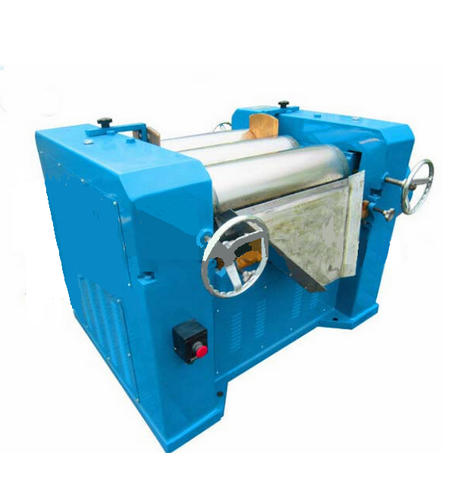
The three roll mill is mainly used to mill various kinds of paste-like materials (except those which can cause corrosion of rolls) such as paint, oil ink, ink, oily pigment, coating, foodstuff, cosmetics etc. Recently it has expanded its application range to raw materials of electric cable, man made leather, plastic, soap and pencil core etc. therefore the machine has become the main equipment for those factories to mill materials.
On the basis of original three roll mill, absorbed advantages of its like both at home and abroad and practical conditions of all users, the modified Model three roll mill has made further improvement. The machine adopts welded structure of quality steel plates therefore it has beautiful appearance, good workability, high strength and long service life. Moreover it can reduce labor strength.
The material of three rolls adopts centrifugally cast cold-hard alloy roll with thickness of alloy layer of 15 – 25 mm and surface hardness of HS 68 – 75. Three rolls are made by grinding on cambered grinder so its effective working surface has a b t cambered. When the three rolls are milling materials, it has features to make automatic compen ation and prolong its service life due to factors of its rigidity and expansion when hot and shrinkage when cold. Meanwhile it can raise up milling efficiency and fineness of materials to be m lled. For normal materials to be milled, it can make milling once, twice or more times in the three rolls depending on their original fineness and toughness in order to reach required fineness (normally at about 0.02 mm, measured by the grindometer).